

For every CIO and CFO I work with in Financial Services, cloud costs have become the conversation that won’t go away. This post explains why — and what it looks like when organisations take back control.
The Bill Arrives. The Board Asks Questions. Who Has the Answers?
Cloud adoption in Financial Services accelerated — as it had to. Workloads moved. Core systems modernised. AI initiatives launched. Digital channels scaled to meet customer expectations for always-on services. But the costs? They grew faster than the visibility needed to manage them.
The result is a challenge I see playing out across banking, capital markets and insurance: a technology estate that is larger, more complex, and less transparent from a financial perspective than at any point in history. Cost allocation is increasingly difficult. Cloud consumption is outpacing budgets. And linking that spend to outcomes — cost-income ratio improvement, cost per policy, trading efficiency — remains stubbornly hard.
“Cloud visibility is table stakes in 2026. What separates the organisations winning the cost conversation from those still fighting fires is the ability to connect every pound of cloud spend to a business outcome — and respond to misalignment automatically, not manually.”
When you can’t answer the question “are we getting real value from what we’re spending in the cloud?”, the risks cascade: budget overruns, accountability gaps, regulatory exposure, and a growing disconnect between the investment made and the business outcomes achieved.
~$1B
CFM market value in 2024 (Gartner)
$1.75B
Forecast market value by 2028
15%
Compound annual growth rate (CAGR)
100+
Vendors globally offering some form of CFM capability
That market size isn’t a technology trend. It’s evidence of how widespread — and serious — the problem has become.
The Financial Services Dimension
This challenge looks different in Financial Services than in other sectors. The pressures here are compounded by five strategic realities that create direct, simultaneous demands on technology teams:
1 – Cost-Income Ratio Pressure
Leadership expects continual improvement in operating leverage. Technology spend must be transparent, benchmarked and actively optimised — not just reported after the fact.
2 – Regulatory Transparency
Supervisory bodies increasingly expect granular, defensible visibility into how technology costs are allocated across products, services and legal entities. “We couldn’t disaggregate it” is not an acceptable response.
3 – Cloud Transformation Risk
Migration from legacy infrastructure to hybrid and cloud platforms delivers agility — but introduces serious financial risk if consumption is not actively governed from day one.
4 – Operational Resilience Constraints
Banking, trading, payments and claims systems must operate within strict availability and performance tolerances. Cost optimisation cannot compromise service integrity — which rules out blunt-instrument approaches.
5 – Capital Allocation Discipline
Technology investments must compete with other capital demands and demonstrate measurable, auditable returns. “The cloud costs what it costs” is a career-limiting answer in 2026.
The common thread across all five is the absence of an integrated view that connects technology spend → consumption → performance → business outcome. Without that, every conversation with the board is a negotiation without evidence.
What Gartner Says: IBM as a Leader in Cloud Financial Management
In September 2025, Gartner published its Magic Quadrant for Cloud Financial Management Tools — an independent evaluation of 13 vendors across Completeness of Vision and Ability to Execute. IBM was named a Leader in the quadrant, placing in the top-right alongside Broadcom (CloudHealth) and Flexera.
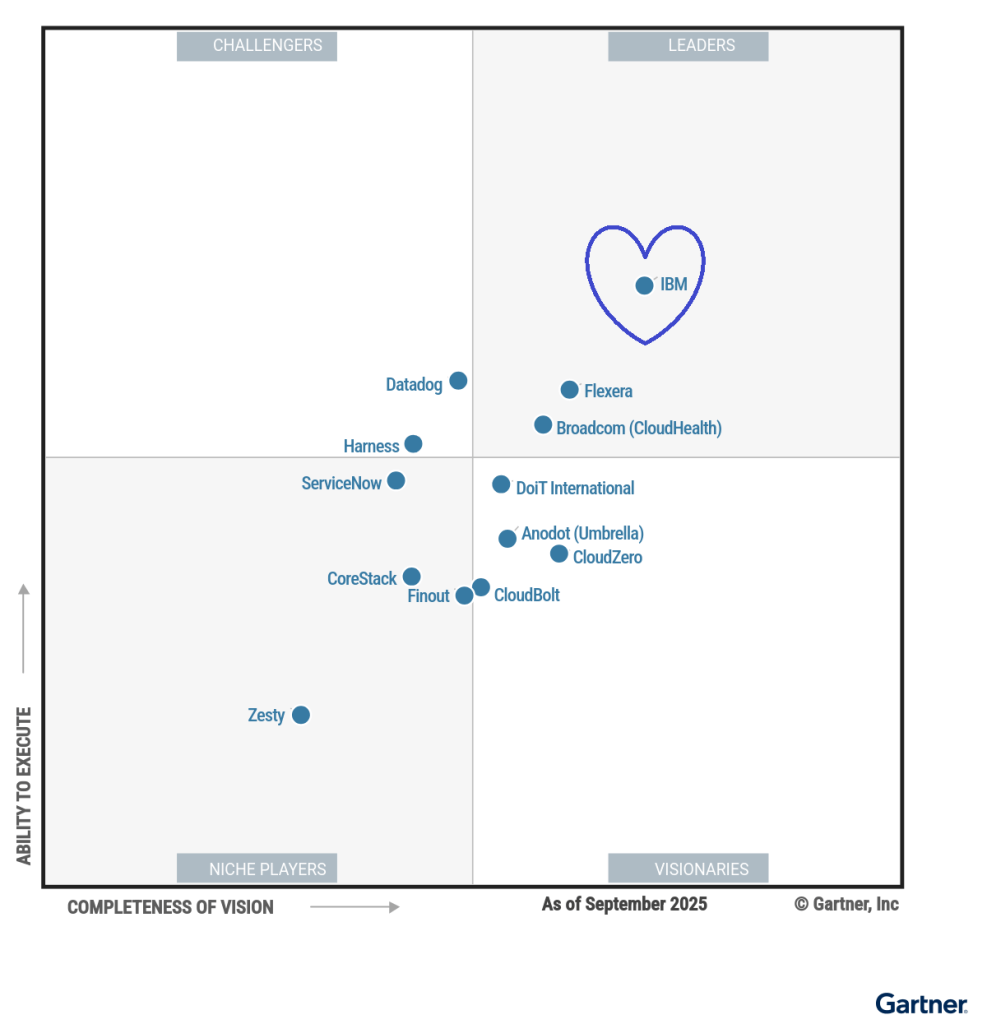
Gartner’s evaluation is not a beauty contest. The Leaders quadrant recognises vendors who combine a broad ability to execute across real-world use cases with an ambitious, credible vision for where the market is heading. IBM earned its position by demonstrating strengths in three areas that matter most to Financial Services organisations:
-
✓
Widest Cloud Provider Support
IBM Cloudability covers AWS, Azure, Google Cloud, IBM Cloud and Oracle Cloud Infrastructure — with relative feature parity across all five. For FSI organisations running heterogeneous cloud estates, this matters enormously. -
✓
Financial Planning Beyond Dashboards
Gartner specifically cited IBM’s financial planning capability as going “beyond the capability of most other vendors,” with better accuracy in predicting spending and stronger support for the finance team in managing cloud budgets. -
✓
Cloud Reselling & MSP/Chargeback Strength
IBM displays strong capabilities in enabling cost association for managed service providers and enterprise groups acting as internal MSPs — critical for large FSI organisations with
The IBM FinOps Suite: A Financial Intelligence Layer for Technology
IBM’s position in the Gartner Magic Quadrant reflects an integrated suite built from strategic acquisitions: Apptio (2023) for IT Financial Management, Turbonomic (2021) for Application Resource Management, and Kubecost (2024) for Kubernetes cost optimisation. Together, they form what I describe to customers as a Financial Intelligence Layer — a closed-loop system that governs technology spend across planning, execution and optimisation.
IBM Cloudability Premium
Multi-cloud cost visibility, automated Reserved Instance and Savings Plan management, unit economics, anomaly detection and forecasting. The cloud FinOps engine.
IBM Turbonomic
Application Resource Management that continuously analyses real-time demand signals and executes policy-driven optimisation — maintaining service levels while driving efficiency.
IBM Apptio ITFM
Enterprise-wide IT financial governance: automated data ingestion, standardised cost models, budgeting, forecasting, showback and chargeback to products and legal entities.
IBM Kubecost
Kubernetes cost management and optimisation — essential as AI workloads increasingly run on container infrastructure, driving a new generation of unpredictable costs.
The real value is in how these capabilities work together. ITFM establishes financial targets and accountability. Cloudability optimises cloud spend within that framework. Turbonomic enforces real-time efficiency while assuring performance. And results feed back into planning, forecasting and executive reporting — creating continuous improvement rather than one-off savings events.
“The question isn’t whether you can see your cloud costs. The question is whether you can connect them to what your business actually produces — and act on that connection automatically.”
Speaking the Language of the Business
| Business Area | KPI Enabled |
|---|---|
| Capital Markets | Cost per Trade (clearing, settlement, execution) |
| Insurance | Cost per Policy · Cost per Claim |
| Retail & Digital Banking | Cost per Digital Transaction · IT Cost per Customer |
| Payments | Cloud Cost per Payment Transaction |
| Risk & Compliance | Infrastructure Cost per Regulatory Reporting Workload |
| Wealth Management | Platform Cost per Client / AUM |
These KPIs transform technology cost conversations from abstract totals into business-relevant efficiency measures — the kind that give a CTO or CIO genuine standing in the board conversation, not just a seat at the table.
What This Looks Like in Practice
Consider a large, diversified Financial Services and Insurance group — spanning retail and commercial banking, payments, wealth management, capital markets trading, and both life and general insurance, serving customers across multiple geographic regions.
Their challenge is representative of what I see across the sector. Years of investment in hybrid and multi-cloud platforms, core system modernisation, data analytics and regulatory capabilities had created a technology estate that was larger, more complex and less financially transparent than ever. Cloud consumption was growing faster than budgets. Cost allocation across products and legal entities was manual and unreliable. Linking spend to outcomes — cost-income ratio improvement, cost per policy, trading efficiency — was aspirational rather than operational.
The IBM Apptio solution addresses this by establishing a closed-loop Financial Intelligence Layer across three integrated capabilities:
ITFM provides the enterprise-wide financial governance foundation — automated ingestion of financial and operational data, standardised cost models, and support for regulatory, audit and management reporting. It answers the fundamental question: where is our technology money going, and who is accountable?
Cloudability Premium brings cloud-specific FinOps: multi-cloud cost visibility across business units and products, automated commitment management, unit economics linking cloud spend to KPIs such as cost per claim or cost per transaction, and anomaly detection to prevent budget overruns before they become a board conversation.
Turbonomic ensures that optimisation doesn’t compromise performance or resilience — continuously analysing real-time demand signals across applications and infrastructure, and executing policy-driven actions that maintain service levels. For payments, trading and claims systems operating within strict availability tolerances, this is non-negotiable.
“For regulated financial services firms, you cannot sacrifice performance SLAs on the altar of cost efficiency. Turbonomic is the only component I’ve seen that handles this constraint properly — optimising intelligently within the guardrails the business actually needs.”
The outcome is an organisation where the technology function can walk into a conversation about cost-income ratio improvement with data, not anecdote — where cloud spending is as transparent and auditable as any other line on the balance sheet.
Why IBM — Not Just Any Tool
There are over 100 vendors globally offering some form of cloud cost management capability. Gartner evaluated 13 of the most significant. So why does IBM’s leadership position matter to a Financial Services buyer?
Three reasons stand out beyond the Gartner positioning:
1. DEPTH OF FINANCIAL GOVERNANCE, NOT JUST CLOUD VISABILITY
Most CFM tools optimise at the cloud layer. IBM’s suite connects cloud FinOps to enterprise IT financial management — enabling the kind of allocation, chargeback and regulatory transparency that FSI organisations need. This isn’t cloud cost reporting bolted onto a billing dashboard. It’s a Financial Intelligence Layer for the entire technology estate.
2. PERFORMANCE-SAFE OPTIMISATION
Turbonomic’s application resource management capability is unique in guaranteeing that optimisation recommendations respect application performance requirements. In Financial Services, where milliseconds matter in trading and payments, and where resilience is a regulatory obligation, this distinction is critical.
3. TRUSTED ADVISOR, NOT JUST TOOLING
IBM’s role in Financial Services accounts is as a long-term technology partner — not a point-product vendor. That means the FinOps suite integrates naturally with broader conversations around Hybrid Cloud strategy, AI adoption, infrastructure modernisation and regulatory compliance. The value compounds across engagements rather than sitting in a silo.
Where to Start: The Discovery & Assessment Workshop
For organisations ready to take this seriously, IBM recommends a phased engagement that begins with understanding before prescribing. The entry point is a structured Discovery & Assessment Workshop — a focused working session designed to establish:
-
1Discovery & Assessment
Baseline your current technology spend posture. Identify where visibility gaps exist, where optimisation opportunities are likely largest, and what the regulatory and audit requirements are for cost allocation.
-
2ITFM Foundation
Establish enterprise-wide financial governance. Build the cost model, allocation methodology and reporting framework that provides the foundation everything else relies on.
-
3Cloudability Deployment
Implement FinOps and cloud optimisation across your multi-cloud estate. Enable unit economics, commitment management, anomaly detection and FinOps practice maturity.
-
4Turbonomic Deployment
Enable automated, performance-safe resource optimisation across applications and infrastructure. Enforce efficiency continuously, within the guardrails your business requires.
-
5Ongoing Value Realisation
Continuous optimisation, KPI tracking, executive reporting and alignment to evolving business and regulatory requirements. The closed loop runs — and improves — permanently.
The Discovery & Assessment is deliberately structured to be valuable in its own right — not a sales process dressed up as a workshop. You will leave with a clearer picture of your current posture and a set of actionable recommendations, regardless of what comes next.
Ready to Take Back Control of Cloud Spend?
If cloud financial management is on your agenda for 2026 — and in Financial Services, it should be — I’d welcome a conversation. Let’s explore whether a Discovery & Assessment workshop makes sense for your organisation.
Leave a Reply